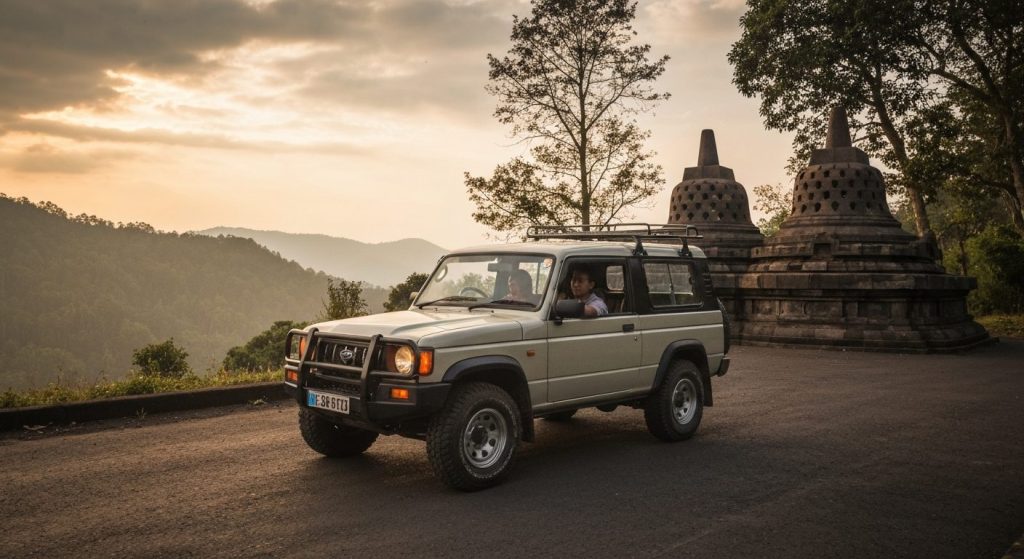
A merapi sunrise jeep tour is a private 4×4 run up Merapi’s southern slopes in the dark, timed so you reach the viewpoint just before first light. On this page I explain how the sunrise and night lava options work, what they cost, what you actually see, and how we arrange them with our vetted local partners.
I’m Raka, Yogyakarta Culture & Heritage Editor at Merapi Jeep Tours. I’ve done the Merapi sunrise route more times than I can count, and my job here is simple: give you the clearest planning guide for sunrise and night-glow trips so you can decide if getting up at 2–3 am is truly worth it for you.
—
## Merapi sunrise vs night-lava vs sunset: which is right for you?
Merapi has several jeep slots across the day. The two that get the most questions are:
– **Merapi sunrise jeep tour** – reach the viewpoint around blue hour, watch first light hit the crater and ridgelines.
– **Merapi night lava tour (glowing)** – go even earlier, to try to see the reddish / phosphorescent volcanic glow before dawn when activity and clouds allow.
Many travellers compare these to the more common **late-afternoon / Merapi sunset jeep tour**. The table below lays them side by side so you can self-select based on sleep, photography, and what you most want to see.
| Tour type | Typical pickup time (from Yogyakarta city) | What you mainly see | Best viewpoint used | Best season / window | Photography payoff | Indicative private tour price band* (IDR / USD) |
|---|---|---|---|---|---|---|
| Sunrise jeep tour | ~03:00–03:30 (jeep area by ~04:15–04:30) | First light over Merapi cone, misty valleys, golden hour on the crater and bunker | Commonly Kaliadem or similar sunrise platform on the south flank (~1,100–1,200 m) | Merapi sunrise tour dry season: roughly May–Oct (clearer dawn skies) | Classic volcano silhouette, pastel pre-dawn sky, good for wide-angle landscapes | ~IDR 900,000–1,500,000 / jeep (about US$60–100) last verified June 2026 |
| Night lava tour (pre-dawn glow) | ~01:30–02:30 (jeep area by ~03:00) | Hoped-for glowing crater / lava dome, long-exposure night sky, then early sunrise | Similar south-side viewpoints; angle chosen nightly for safest, clearest view | Dry season & periods of visible dome activity; glow never guaranteed | Astro-style shots, glow (if visible) with foreground ridges, light trails | ~IDR 1,200,000–1,900,000 / jeep (about US$80–125) last verified June 2026 |
| Sunset / late-afternoon lava tour | ~14:30–16:00 (jeep area by ~15:30–16:30) | Crater view in daylight, disaster museum, bunker, late light on slopes; some trips stay until after sunset | Daylight viewpoints on south side; sometimes short night segment for glow if conditions permit | Most of the year; afternoon clouds are common Dec–Mar | Clear daytime crater context, village ruins, easier for families | ~IDR 700,000–1,300,000 / jeep (about US$45–85) last verified June 2026 |
*Prices vary by season, route length, hotel pickup distance and group size; they are indicative only, not a fixed quote from any single company.
If your main aim is **golden light and a clear cone silhouette**, choose the **merapi jeep tour sunrise**.
If you are specifically chasing the **merapi lava tour glowing crater / phosphorescent glow**, then you want the **merapi night lava tour glowing** variant that starts around 2 am.
—
## Who actually runs these tours?
Bali Premium Trip is a Bali- and Java-focused operator that plans Merapi, Borobudur and Prambanan trips for private groups. We:
– Arrange **private car transfers** from your hotel in Yogyakarta.
– Book a **licensed Merapi jeep operator** and local guide on your chosen route.
– Coordinate **start times, viewpoint choices and parking** so you know where to be and when.
– Help you fit Merapi around **Borobudur, Prambanan, the Kraton and Taman Sari** in one coherent Yogyakarta plan.
We **do not own** Merapi National Park land, access roads, or concessions. Those are managed by local authorities and community-run jeep cooperatives. Park rules, safety closures and viewpoint access can change with volcanic activity; that part is not ours to control.
When you book through us, we pair you with vetted partners we know personally from years on the mountain. Because Merapi Jeep Tours is operated by Bali Premium Trip, you book directly with our own reservations team at transparent, published rates — with no third-party markup or hidden commission.
Booking is kept simple and human:
– **WhatsApp**: +62 811 2859 0000
– **Email**: [email protected]
Or you can plan your trip via our form and ask for “Merapi jeep tour early morning 4am pickup”.
—
## Your 4am to sunrise timeline: how the tour actually runs
Timings vary slightly with season (sunrise in Yogyakarta ranges roughly from 05:20 to 05:45) and your hotel location, but a typical **merapi sunrise jeep tour** or **night lava run** from the city looks like this.
### 01:30–02:30 – Hotel pickup (night lava variant)
For the **merapi night lava tour phosphorescence glow** option, your driver usually collects you between **01:30 and 02:30**:
– Private **air-conditioned car** from your hotel in central Yogyakarta or the Prambanan area.
– Drive time to the jeep base on Merapi’s southern flank is **~60–90 minutes** depending on traffic and exact base used.
The car is smoother and quieter than the jeep; you can doze a little on the way up.
### 03:00–03:30 – Switch to jeep and brief
At the jeep base area (typically around **800–900 m elevation**) you:
1. Meet your **licensed jeep driver and local guide**.
2. Use toilet facilities and do a quick **gear check** – headlamps, jackets, camera settings.
3. Receive a **safety briefing**: how to sit, where to hold, what to do over rough ground and if volcanic alerts change.
Most jeeps carry **3–5 guests comfortably**. Larger groups usually use **two or more jeeps** and drive in convoy for both safety and atmosphere.
### 03:15–04:00 – Night run toward the crater (night-lava focus)
The **night lava tour glowing** variant spends the darkest hour between 3 and 4 am trying to get a safe, clear angle toward Merapi’s dome. Expect:
– A **bumpy 20–40 minutes** on rocky lava tracks. This is not technical off-roading, but you will feel the ruts and loose stones.
– Several **short stops** where your guide checks the sky, cloud cover and current activity.
– If conditions allow, a **long-exposure stop** at a viewpoint with a line of sight to the upper dome or glowing rockfalls.
Important expectation check:
– The **glow is highly variable**. On some nights you see clear red-orange points and streaks from the dome or rockfalls. On others the crater is quiet or hidden in cloud.
– No operator can guarantee a **merapi lava tour glowing crater** view. Any promise of “100% glowing lava” is not honest.
Your guide will tell you what is realistic that night, based on the **volcanology reports (BPPTKG)** and their own eyes.
### 04:00–04:30 – Standard sunrise start (for both variants)
If you are on the **sunrise-only tour**, your pickup from the city is later, around **03:00–03:30**, aiming to reach the jeep base at about **04:15–04:30**. You then:
– Transfer to the jeep.
– Do the same safety brief.
– Climb toward the **sunrise viewpoint** in the pre-dawn dark.
By around **04:30–04:45**, both the night-lava and sunrise-only groups are usually converging on one of the **approved sunrise platforms** on Merapi’s south side.
Common spots include:
– **Kaliadem Bunker area** – famous for its proximity to the 2006 lava flow burial site.
– Other south-side ridges around **1,100–1,200 m elevation**, chosen nightly depending on wind, ash and crowding.
Exact spots vary because:
– Park authorities can **close or re-route tracks at short notice** due to activity or erosion.
– Some viewing decks are run by local communities and may change opening hours or access policies.
We plan your route with the operator a day or two before, but the final call at 4–5 am always rests with local authorities and conditions.
### 04:45–05:30 – Blue hour and first light
This is the part that makes the lost sleep worthwhile for most travellers.
Typical sequence:
– **04:45–05:00** – Arrival at the viewpoint. The sky is dark blue. Merapi is a dark shape against the horizon.
– **05:00–05:20** – **Blue hour**. The eastern sky brightens, stars fade, and the outline of Merapi and the nearby Mount Merbabu becomes clear.
– **05:20–05:45** – **Sunrise and early golden light**. The sun clears the horizon, painting the crater rim and ridges in warm light.
If you did the **night lava tour**, you now shift from long-exposure tripod work to classic sunrise frames: wide landscapes, silhouettes of the jeep, people in foreground.
### 05:30–07:00 – Post-sunrise jeep circuit
Most sunrise programs don’t drive straight back after first light. Instead you typically:
– Visit the **Kaliadem bunker** and learn about the 2006 eruption and the people who sheltered there.
– Stop at a **disaster museum or local house** preserved from the 2010 eruption, where your guide explains how the flows moved and how villages rebuilt.
– Drive a **shorter off-road loop** on rivers of compacted ash and rock, good for action shots with the jeep.
The full jeep portion usually lasts **2–3 hours** depending on how many stops you decide to make.
### 07:00–08:30 – Return to Yogyakarta city
Back at the jeep base, you switch again to your private car:
– Quick **toilet and coffee stop** at the base warungs (stalls).
– **60–90 minutes** drive back to the city, depending on where you’re staying.
Most guests are back at their hotel for breakfast between **08:00 and 09:00**, with the rest of the day free for **Borobudur, Prambanan, the Kraton or Taman Sari**.
If you want to string these together, ask our team to help you plan your trip via WhatsApp so your Merapi run dovetails neatly with temple opening times and traffic.
—
## What you actually see: glow, crater, valley and village
### The glowing crater and phosphorescent effect
For the **merapi night lava tour phosphorescence glow**, what you’re hoping to see is:
– **Incandescent rock** in the crater or on the lava dome, appearing as red or orange pinpoints.
– Occasional **lava rockfalls** that trace brief red lines down the upper slopes.
– The **“phosphorescence” effect** – a soft, eerie glow in the crater area when low cloud reflects the light from hot material.
Key points:
– Visibility depends on **two moving targets**: Merapi’s activity level and the amount of **cloud, mist or ash** in front of the dome.
– Some months the dome glows frequently at night; others it’s mostly quiet. We follow **daily volcano bulletins** to pick the best windows, but we can’t control the mountain.
If the glow is weak or hidden, your guide will pivot to **night sky and jeep photography** instead: stars over the cone, light painting with the jeep headlights, and silhouettes.
### The sunrise cone and valley
On a **merapi jeep tour sunrise** run in dry season, you can usually see:
– The **sharp outline** of Merapi’s cone against the eastern sky.
– **Merbabu and surrounding peaks** in the distance, sometimes with a cloud inversion below.
– The **river valleys filled with mist**, with occasional village lights twinkling below.
Dry-season sunrises (roughly **May to October**) tend to be clearer, with:
– Less morning rain.
– Lower humidity and haze.
– Longer periods of visible cone before clouds build later in the day.
Wet-season sunrises (roughly **November to April**) can still be rewarding, but:
– There is a **higher chance of low cloud** around the summit at dawn.
– Trails can be **slipperier**, and visibility can change more quickly.
No operator can promise a perfectly clear cone. Even on a good day, Merapi likes to wear a small hat of cloud.
—
## Merapi sunrise photography: what works and what doesn’t
Many guests ask us to set up their **merapi jeep tour sunrise photography**. Here is the practical side, from seeing hundreds of attempts.
### Lenses and cameras
You do not need a professional setup, but equipment affects results:
– **Smartphones** – Modern phones do surprisingly well at blue hour and sunrise, less so for distant crater detail or long-exposure glow shots.
– **Mirrorless / DSLR** – Best balance: one body and **two lenses** is enough:
– Wide-angle: **16–35mm** equivalent for landscape and jeep shots.
– Short telephoto: **50–100mm** for closer views of the cone and any visible glow.
Tripods help for the night-lava segment, but on a private jeep with **3–5 guests** you must keep gear compact.
### Camera settings (starting points, not rules)
For **night lava glow** (if visible):
– Mode: Manual
– Aperture: f/2.8–f/4
– ISO: 1600–3200 (or as high as your camera can handle without ruining detail)
– Shutter: 5–15 seconds, experiment to avoid blowing out the glow
For **blue hour and sunrise**:
– Mode: Aperture Priority or Manual
– Aperture: f/5.6–f/8 for landscape sharpness
– ISO: Start 400–800 in blue hour, drop to 100–200 after sunrise
– Shutter: Let the camera choose in Aperture Priority; check histograms instead of the LCD alone.
Your guide and driver are used to photography stops; just **tell us in advance** if photography is your top priority so we build slightly more buffer for shooting.
—
## What to wear on a Merapi sunrise jeep tour
People often underestimate how cold, dusty and variable Merapi’s pre-dawn can be. Here is a short, honest list for **what to wear merapi sunrise jeep tour** sessions.
### Temperature and comfort
At **1,100–1,200 m** before sunrise, expect:
– Dry-season lows: typically **14–18°C (57–64°F)**, sometimes colder with wind.
– Wet-season dawn: slightly warmer but **damp and windy**.
Clothing strategy:
– **Base layer**: T-shirt or light long-sleeve.
– **Mid-layer**: Fleece or light sweater.
– **Outer layer**: Windproof jacket or a light rain shell in wet months.
You will sit still at the viewpoint for **30–60 minutes**. People who dress “city-warm” often get chilled there.
### Footwear and dust
The tracks are:
– **Uneven, rocky, dusty**. Sometimes muddy after rain.
– Short walks only (usually **under 500 m** at a time), but you step on loose stones.
Wear:
– Closed shoes with **good grip** – trainers or light hiking shoes.
– Avoid flip-flops and delicate sandals; dust gets everywhere.
A simple **mask or buff** helps with dust, especially in the jeep. Your guide usually carries disposable masks, but a buff is more comfortable.
### Other essentials
– **Headlamp or small torch** – the jeep has lights, but the paths to the viewpoint often don’t.
– **Hat and thin gloves** for those who feel cold easily.
– **Water bottle** – at least 500 ml per person; you can buy more at base warungs.
– **Small daypack** – to keep hands free while climbing into/out of the jeep.
You do **not** need full technical hiking gear; this is more about **comfort and dust** than altitude or distance.
—
## Safety, regulations and what we control (and don’t)
### Volcanic activity and closures
Merapi is an **active stratovolcano** monitored closely by Indonesian authorities. Important points:
– The **exclusion zone radius** is set by the **BPPTKG and local government**, not by tour operators.
– Jeep routes and viewpoints stay **outside official danger zones**, and are adjusted when alert levels change.
– In periods of raised alert, authorities can **suspend jeep operations entirely or limit them** to safer sectors.
If this happens close to or on your tour date, we will:
– Explain your options clearly – postponement, alternative timing (e.g., daytime instead of night), or a different Yogyakarta activity.
– Work with our partners on **fair refunds or rerouting**, according to the terms agreed at booking.
We do not override official instructions. Your driver and guide take their cues from the **volcano observatory posts and local command**.
### Jeep and road safety
Merapi jeep tours use **modified 4x4s** (often older Jeeps and Land Cruisers) with:
– Bench-style seating in the back.
– Roll bars, but usually **no seat belts** in the open rear.
– Low-speed driving on rocky tracks; typical tour speeds are **under 30 km/h**.
Risk factors:
– Sudden jolts on rocks can cause bumps and minor strains.
– People standing or filming while the jeep moves can lose balance.
To stay safe:
– Stay seated while the jeep is moving.
– Put cameras and phones on a **strap**; dropping them on the track is a common mishap.
– Tell us in advance about **back, neck, pregnancy or mobility issues** so we can:
– Choose gentler routes.
– Shorten the off-road segment.
– In some cases, advise a **daytime car-based viewpoint** instead of deep tracks.
Our partners carry **basic first-aid kits** and the routes stay within **~20–30 minutes** of paved roads where standard ambulances can reach.
—
## Costs, inclusions and how to book
Every Merapi operator structures packages slightly differently. Here is a realistic **price and inclusion overview** for private sunrise and night-lava runs, based on checks with multiple local providers (last verified June 2026).
### Indicative price ranges (private basis)
Per **jeep**, not per person:
– **Sunrise jeep only (start at Merapi jeep base)**
– Jeep + local guide + basic mask/helmet (if used)
– ~IDR 550,000–900,000 / jeep (about **US$35–60**)
– **Sunrise from Yogyakarta city (with private car transfers)**
– Hotel pickup/return + jeep + guide
– ~IDR 900,000–1,500,000 / jeep (about **US$60–100**)
– **Night lava + sunrise combo from Yogyakarta**
– Earlier start, extra time on mountain, jeep + guide + car transfers
– ~IDR 1,200,000–1,900,000 / jeep (about **US$80–125**)
Variables that change the price:
– **Pick-up point**: central city vs. outskirts or airport area.
– **Number of jeeps** needed for your group (3–5 guests per jeep is comfortable).
– Seasonal demand around **Christmas–New Year, Lebaran (Eid) and school holidays**.
– Added stops at **Borobudur or Prambanan** on the same day.
We confirm the exact figure for your date and plan when you contact us; these are **reference bands only**, not a fixed quote.
### Typical inclusions and exclusions
Often **included**:
– Private **AC car** from your hotel and back (for city-based departures).
– **Jeep and licensed driver** for 2–3 hours.
– Local **guide** who explains the eruptions and village history.
– Simple **mask or buff** against dust.
Commonly **not included**:
– Breakfast (you usually eat at your hotel on return).
– Travel insurance – we recommend you arrange a policy that covers **off-road vehicle excursions**.
– Tips for driver and guide (optional and up to you).
To set up your own run or combine it with Prambanan, Borobudur, the Kraton or Taman Sari, you can message us directly:
– WhatsApp: **+62 811 2859 0000** (text, voice or call; English and Indonesian spoken)
– Email: **[email protected]**
Or send an outline via our form: plan your trip and mention “Merapi sunrise / night lava”.
—
## Pairing Merapi with Yogyakarta’s temples and palace
Many visitors have just **2–3 days** in Yogyakarta and want to see:
– **Merapi** (sunrise or night lava).
– **Borobudur** at first light or early morning.
– **Prambanan** in late afternoon or at the **Ramayana ballet**.
– **Kraton** and **Taman Sari** for palace culture.
A workable no-rush combo could look like:
– **Day 1**: Arrival, Kraton and Taman Sari in the morning, Malioboro in the evening.
– **Day 2**: Merapi sunrise jeep tour (back by 09:00), rest, **Prambanan + Ramayana** in late afternoon and evening.
– **Day 3**: **Borobudur early entry** (or standard morning visit), countryside lunch, airport/train.
If you want to add the **night lava** element, most people place it before a **rest or lighter day**, not back-to-back with another 3 am wakeup like Borobudur sunrise.
We help fine-tune this based on:
– Your **arrival and departure times**.
– How many early starts you realistically want.
– Your interest in **palaces vs. countryside vs. temples**.
—
## FAQs: Merapi Sunrise & Night Lava Jeep Tour
Is the Merapi sunrise jeep tour safe for children?
Many families bring children aged 6 and above on the sunrise jeep route. The tracks are bumpy but not extreme, and we can choose gentler lines. For younger children or anyone who dislikes rough rides, we can shorten the off-road section and focus more on viewpoints reachable by better-maintained tracks. Always let us know your children’s ages in advance so we can match you to the right driver and route.
Can you guarantee I’ll see the glowing crater on the night lava tour?
No. The glowing crater and phosphorescent effect depend on Merapi’s activity level, cloud cover and visibility on that specific night. Some trips see clear red glow and rockfalls; others see only a dark crater silhouette and night sky. We schedule your departure time to maximise your chances based on current reports, but no operator can honestly guarantee glow.
How far in advance should I book a Merapi sunrise or night-lava jeep tour?
For dry season (roughly May–October) and Indonesian holidays, booking at least 1–2 weeks ahead helps secure preferred start times and enough jeeps for your group. Last-minute trips a day or two before are often still possible on quieter dates, but specific time slots (e.g., very early night-lava starts or combined temple itineraries) may be limited. A quick WhatsApp message is usually enough to check availability.
Will the tour still run if it rains?
Light rain does not automatically cancel Merapi jeep tours; drivers carry basic rain covers and the vehicles can handle wet tracks. Heavy rain, thunderstorms or ashfall, however, may trigger delays, route changes or cancellations based on local authority guidance. Safety comes first, and we will coordinate options with you and the operator if weather or volcanic alerts affect your slot.
Can I do Merapi sunrise and Borobudur sunrise on the same morning?
Realistically, no. Merapi sunrise and Borobudur sunrise overlap in timing, both needing a pre-dawn departure. It is more practical to give each its own morning: one day for Merapi sunrise or night lava, another for Borobudur early entry. This avoids exhaustion and rushed visits. We can help you sequence them over two or three days so you still see Merapi, Borobudur and Prambanan within a short stay.